HEIDI VAN MASTRIGT
‘If the feet are weak, you have a weak foundation. Just like you wouldn’t build a house on sand, you can’t expect strength, stability, or performance if the base isn’t solid.’

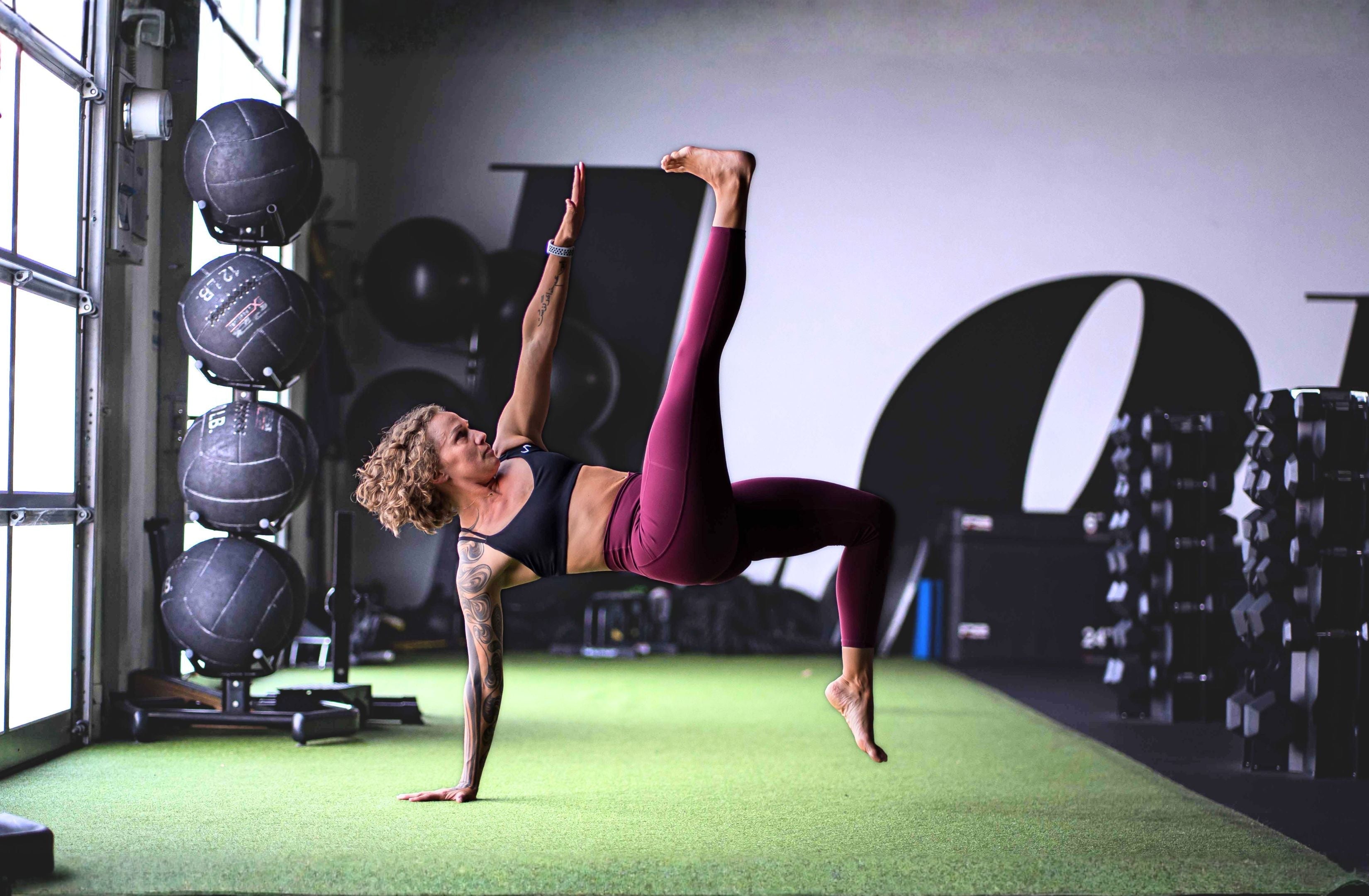
Heidi Van Mastrigt is a strength coach and movement specialist with over 14 years of experience in the fitness and performance world. After starting as a competitive dancer and later competing in powerlifting, recurring injuries led her to question traditional training approaches and explore the role of foot function in whole-body movement. Today, she specialises in helping athletes restore healthy movement patterns through foot strength, fascial integration, and progressive strength training. She is also a NASM-certified personal trainer, corrective exercise specialist, and the founder of Barefoot Strength and Performance.
You grew up dancing 10 to 20 hours a week and pushing your body to its limits. When you faced an early retirement from dance, how did that moment change the way you look at the body?
I definitely went through an identity crisis, like most people do. I went through my own ups and downs with my body and how my body changed through that. When I stopped dancing, I really had no direction. It wasn’t until I got into powerlifting, which is on the total opposite end of the spectrum of dance, that I started to regain my confidence and regain that fire for movement again.
The biggest thing that happened within all of that was the foot injury. I broke my foot when I was really at the peak of my dance career. I was 18, two weeks before competition was starting. I rolled my foot, an inverted ankle roll, and my fifth metatarsal just cracked. It took a long time for me to appreciate my feet. It took years after that break for me to even realise that your feet are important. That was a really big, pivotal moment within my dance history and why I’m here today.
Did you start focusing on foot training right away, or did it take time to realise its importance?
It took me years. People come to me because of feet, obviously. That’s what I specialise in and what I’ve spent so many hours studying and implementing in training, with clients and with myself. The funny thing is, I didn’t pursue feet and foot function because of foot pain. I actually didn’t really have foot pain, and I think that’s why it took me so long to connect those dots.
The real reason I started focusing on my feet was that I kept hitting walls in my powerlifting progress. I had pain in my hip, my neck, and my shoulder. It took me a long time to connect those dots, especially because I broke my left foot, but it was my right hip and my right neck that were in pain. I went to a lot of professionals, but I never really got results or relief. It wasn’t until around 2018, when I came across Anatomy Trains, that it really clicked and I realised it was my foot.
Note: Anatomy Trains is a system developed by Thomas Myers that maps how muscles are connected through fascia across the whole body. It is available through books, courses, and professional certifications for movement and therapy practitioners. Learn more about Anatomy Trains here.

Can you expand on what Anatomy Trains is and how it impacted your journey?
Anatomy Trains essentially shows the different fascial lines, or fascial meridians, in the body. That was the thing that made the big light bulb go off for me. I realised, oh my goodness, it is my foot. My foot is the reason all this is happening. From there, I went really deep into Anatomy Trains and Tom Myers’ work. I also revisited my own educational background in fitness, human movement, physiology, and anatomy, and realised I must have just missed it.
Did you start prioritising minimalist footwear at that stage, or did that come later?
I was actually introduced to barefoot shoes back when they first had a big boom in the early 2010s. Ironically, I was working at a comfort shoe store, my first job at 17, where I was learning about arch support and different comfort shoe brands. We got a shipment of Vibram FiveFingers, and that was my first introduction. I tried them on and thought, oh, these are amazing, without really knowing anything about feet. I trained in those for a few years.
As I got more into powerlifting and functional training, I moved away from barefoot shoes for a while. It wasn’t until around 2019, when I had my daughter, that I made the decision to wear barefoot shoes as much as possible. At that time, they weren’t as popular or easy to find. I went through phases of wearing Converse for lifting and Nikes for running, just because that’s what I had.
When did you fully transition to minimalist footwear, and what did that process look like?
Around 2022 or 2023, I made the full switch. I got rid of everything, donated all my shoes, and kept just a few pairs of barefoot shoes. From there, I built back up gradually. It takes time. It takes training and addressing dysfunction to use minimalist shoes properly. That’s the biggest mistake people make. They think minimalist shoes will solve their problems straight away, and often the first thing they want to do is run in them. But it doesn’t work like that. They can be great, but only if your feet are strong, functioning well, and connected to the rest of the body.
Now my feet are strong enough that I could run barefoot on concrete if I needed to, but it’s not something I do, and it’s not for everyone.

When is it appropriate to use highly cushioned footwear?
I think highly cushioned footwear has a place in trauma. If there’s been trauma to the feet, whether it’s an injury or surgery, of course we need to provide some level of support and cushioning so people can go about their daily lives. However, the problem is that most people get stuck there. The reality is the feet are no different from any other part of the body. If you wear a back brace because of back pain and then keep it on forever, what happens when you take it off? You would be in pain and likely at risk of injury. The feet are the same in that sense.
There is a time and place for cushioning. In addition to trauma or recovery, there are cases where people work long hours on hard surfaces like concrete and don’t have the opportunity to give their feet any variation. What the feet really need is variety in texture and terrain to avoid that heavy, achy feeling. But in some situations, yes, people will need cushioned shoes simply to function and get through their day. Over time, the goal can still be to build function and strength, but that process may take longer depending on the individual.
What are the most common causes of foot pain today?
It really depends on who we’re talking about. For the general population, it’s a sedentary lifestyle, combined with highly cushioned, high-tech shoes. We’re putting these rigid, cushioned shoes on toddlers as soon as they start walking, and then that’s all they wear their whole lives. So, by the time we reach adulthood, we wonder why our feet are weak, why we can’t walk barefoot without pain, or why things like plantar fasciitis flare up.
With athletes, a lot of it comes down to their shoes. Most shoes are very narrow, with tapered toe boxes, and often quite rigid. I always tell people to look at a baby’s foot. It has a narrow heel and gradually gets wider, with the toes being the widest part. Then you compare that to an adult who has worn conventional shoes their whole life, or an athlete wearing cleats or running shoes. Over time, the foot adapts to the shape of the shoe. What ends up happening is that people develop what I call ‘shoe-shaped feet’. The toes deform to fit into the shoe, and they are no longer the widest part of the foot. That becomes normalised, but it’s not how the foot is meant to function.

You often talk about integration in the context of injury recovery. What does that actually mean in practice?
Integration means that we are integrating movement from the ground up. We are looking at how the foot is functioning on its own first. Can you splay the toes? Can you lift the big toe independently? Do you have a good range of motion in the ankle, things like dorsiflexion and tibial rotation. All of that matters.
Where it really comes together is when we can take that function and strength from the foot and translate it up the chain. I see this a lot, especially with athletes; there is often a big disconnection between the feet and the hips. That’s where issues like knee pain tend to show up, and often it means the feet and hips are weak. The body is a connected system, nothing works in isolation. That’s why integration is so important, not just for injury recovery but also for performance and long-term health.
If pain doesn’t always originate where it is felt, how do you identify the root cause?
Sometimes you don’t. In my case, it became obvious once I connected the dots, because the only real trauma I had experienced was that broken foot. I broke my foot, and then the pain started to show up elsewhere. Now, with the knowledge I have, I can look back at old pictures and clearly see that my feet were very dysfunctional, very weak, and out of alignment, so it makes sense that the pain moved up the chain.
In some cases, people do have a clear injury, and the body reorganises and compensates around it. But in other cases, it’s harder to pinpoint one exact cause, because the body is a system and nothing works in isolation. Sometimes people have had small incidents they don’t even remember, like stubbing a toe, which can still create dysfunction over time. So while it can be difficult to identify one single cause, often you can trace it back to some form of trauma or imbalance that the body has adapted to.
What are fascial lines, and what disrupts their function?
Fascial lines are essentially connections. There are bony points where we connect, and then you have tendons, muscles, and ligaments creating continuous connections throughout the body. There’s a lateral line, a deep front line, a superficial back line, all these different lines.
In terms of what disrupts their function, trauma is a big one. It could be something like the foot that I broke. Yes, I broke a bone, but the more traumatic part was actually the strain on the ligaments and tendons. These tissues take much longer to heal, mainly because their blood supply is not as strong. It could be a tear, a strain, even a bruise.
There’s a book, I can’t remember the exact title, but I believe it’s by Carla Stecco, where she shows the different layers of fascia. She explains that when we cut into the fascia, for example in surgery, we completely disrupt that connection. Then scar tissue forms where that incision was, and it’s no longer a smooth connection.

How does neglecting foot training affect the rest of the body?
If the feet are weak, then you have a weak foundation. It’s like building a house; you wouldn’t build it on sand, you build it on something solid. The feet are no different. If the foundation is weak, you can’t expect everything above it to function properly. You can’t expect to have strong calves, strong hamstrings, strong glutes. Especially in the athletic world, you can’t expect to reach your potential or keep improving strength, speed, or endurance if that foundation is lacking.
What are the most common foot issues you see in dancers, and how do they impact movement and performance over time?
With dancers, bunions are probably the biggest issue I see. Achilles problems are also very common, but bunions are really the main one. A bunion is when the big toe starts shifting towards the smaller toes, while the metatarsal moves in the opposite direction, creating an unstable joint. This is a problem because the big toe joint is one of the most important joints in the body. It’s where we are meant to roll through when we walk and run, and it’s actually the most robust joint in the foot.
When that joint becomes unstable, gait is affected, so the way you walk changes. There are also important muscles that attach there, like the fibularis longus and the anterior tibialis, and when there is instability, those muscles can’t function properly. The body will adapt, but when we’re talking about performance longevity and high-quality movement, those things start to suffer. You lose the ability to connect efficiently through the body, including the fascial lines and the glutes, and that’s often when pain starts to show up.

Where does the pain typically show up when someone has a bunion or related dysfunction?
It depends. Sometimes it is in the foot, the bunion itself can be painful. But often, the pain shows up elsewhere, especially in the knees. When the big toe starts shifting towards the smaller toes, it opens the door for more pronation than there should be. [Editor's note: Pronation is the natural inward rolling of the foot when we walk, but when it becomes excessive, it can create instability.] That extra movement in the foot can lead to issues like posterior tibial tendon dysfunction or pain along the inside of the lower leg. From there, it can move up to the knee. If the foot is pronating more than it should, the knee also has more room to move towards the midline, what we call knee valgus or knee caving. That places stress on the tendons and ligaments that stabilise the knee. So in terms of pain, it really depends on the person, their movement patterns, and how long they’ve been dealing with it, but those are some of the most common areas.
Can bunions be reversed, and how long does it take?
It’s a very loaded question. It really depends on how long you’ve had them and how severe they are. In my own case, I had a pretty significant bunion on my left foot, the one I broke, and now it’s nowhere near as noticeable. You wouldn’t even be able to tell it was that bad. But I think that has more to do with the strength I’ve built and my ability to access better ranges of motion.
Not everyone is going to see that level of change, especially in more severe cases. But that doesn’t mean all hope is lost. When it comes to aesthetics, that shouldn’t be the main focus anyway, even though it is a concern for many people. Even if you can’t drastically change how the bunion looks, you can still improve strength and stability in the foot, and therefore in the rest of the body. That’s what helps reduce pain and improve function over time.
Would the same apply to Morton’s neuroma, or is that different? And can you briefly explain what it is?
I’ve never had it formally diagnosed, but I do think I had a neuroma in my left foot, the one I broke. When I first started doing more footwork, like toe squats holding a kettlebell, I would get shooting pain in that foot. With neuromas, it can feel like a little bump under the ball of the foot, almost like a ‘speed bump’ when you roll over it, and I had that as well.
A neuroma is essentially a thickening of the nerve between the metatarsals. There’s no way to fully get rid of it unless you have surgery. But in my experience, and what I’ve seen with others, when you improve the function of the foot, it can become a non-issue.
It took time. I trained with toe spacers for years and worked on improving my foot function. The key is changing how the foot loads. Neuromas often happen because we are putting pressure through parts of the foot that are not meant to take it, instead of rolling properly through the big toe. When you restore mobility, create space between the metatarsals, and learn to engage the big toe again, you’re no longer loading that area in the same way. So it’s not about reversing it, but about improving function to the point where it no longer causes problems.

Why do you think that in foot-related pathologies, rehabilitation is often not properly addressed?
The reality is that most doctors are simply not trained in this. They don’t get that kind of education. I didn’t get it either. Everything I know, I had to go and find myself. I read a lot, studied different models of the foot, and then experimented on myself and with my clients.
We’re still very early in these conversations. Hearing real experiences helps people realise that it is possible, that there are alternatives. But it’s new. If you had told me ten years ago that you need to train your feet, I would have said, what are you talking about, how do you even do that? So a lot of the time, people don’t even consider it until they’re already in pain. And by then, they’re often looking for faster solutions, instead of something that takes time, consistency, and care.
If someone has very weak feet, where should they start in terms of tools and training?
Pressure is my go-to. Deep pressure, starting wherever you’re at. I personally love The SoleMate for this, but you can use anything that isn’t flat, a curb, a tree root, a lacrosse ball, a tennis ball.
Most people are familiar with rolling the foot on a ball, especially after foot pain, but the real benefit comes from deep pressure and getting those joints moving again. Modern life and rigid, cushioned shoes make the feet very stiff, so stepping on uneven surfaces often becomes painful because the foot has lost the ability to adapt. Our feet should be able to change shape, just like our hands do when we grab something. A simple starting point is exposing them to different textures and uneven surfaces again.
How often should you use toe spacers, and when does it become too much?
Your body will tell you. Even for me, it’s not normal to have our toes spread like that for long periods of time. At some point, your body will say this is too much and you need to take them off.
In terms of how long, it really depends on the person, how tight their toes are and how they respond. As for frequency, as often as possible, but with awareness. Toe spacers are a great starting point because they’re easy. That said, they are just a starting point. You eventually have to move beyond them. You can begin passively, just wearing them while resting, and then gradually start moving in them. I found it especially useful to train in them, because they help increase blood flow and allow for more movement, so discomfort doesn’t come on as quickly. The key is to progress gradually, start passive, then add movement, and eventually build strength in the foot.

Are there simple exercises that almost anyone can start with to build stronger feet?
Yes, absolutely. One of the first things is being able to lift your big toe independently from the others. Most people can’t do it, but we should be able to. Another is an active toe splay.
A great place to start is sitting with your feet in front of you, actively spreading the toes, reaching them out, then curling them in, and going back and forth. For most people, this is quite frustrating because they realise they don’t have that control. The brain is telling the toes to move, but the connection isn’t there. You can also check whether you can lift your big toe on its own and reach your pinky toe out. These are things we should be able to do easily, but most people can’t.
Beyond toe control, what else should people be working on to strengthen their feet?
That’s really just the tip of the iceberg. We haven’t even touched on basic things like calf raises or toe raises, going up onto your toes to engage the calf, or lifting the toes to engage the shin. These are key muscles in the lower leg, and most people are very disconnected from them and quite weak. There’s actually a lot we can do when it comes to training the feet, but it’s often overlooked.
In my experience, recovery for foot and lower leg injuries is very limited. The foot is such a complex structure, it moves in many directions, but most people are only given a few basic exercises and then sent on their way. That’s often why they don’t fully regain their previous level of function.
What is the Weck Method, and how does it relate to training?
The Weck Method was created by David Weck and it focuses on rotational movement. It’s about how the body rotates and coils, and how that is often missing in traditional training.
A lot of athletic training focuses on stability and anti rotation, which still has its place, but the method emphasises how the spine rotates and how that connects through the rest of the body. It looks at movement through sling systems, like the connection from one shoulder to the opposite hip, and how those patterns extend all the way down to the feet. It’s a more integrated approach to movement, with new concepts and tools designed to train the body as a connected rotational system.

What would you say to someone who feels like their body is starting to fail them after years of being highly fit?
It’s definitely not the beginning of the end. I feel like I’ve been through this myself, and in some ways, I feel lucky it happened when I was younger, because most people go through that later.
I would say your body is not failing you, you just need to find new ways to move and new ways to strengthen. Pain signals like that are often your body saying, I need something different, I need a new stimulus. A lot of these aches and pains come from repetition, doing the same movements over and over again. Of course, we’re all going to age, there’s no escaping that. But there are ways to support the body, making sure we’re eating well, staying hydrated, managing stress. At the end of the day, we still need variety in how we move. We’re not meant to just move in the same way all the time.
Heidi, where can people find you, and how can they work with you?
I’m based in Lake Forest, California, in Orange County, and I train in person at Legendary Strength Co. For those who are not in the area, I am working on offering consultations in the future. For now, the best way to connect with me is through Instagram, or you can send me a DM or an email at heidi@thatbarefootcoach.com.
My main focus at the moment is Instagram and in-person training at Legendary.
*This interview was originally featured on The Flexi Podcast, the LEMAlab® podcast hosted by Erika Lemay. The full episode is available on Spotify and YouTube.