JOÃO GODINHO
‘It’s not like what you see in videos. There are tears, pain, sometimes depression, but also happiness. It’s a rollercoaster.'

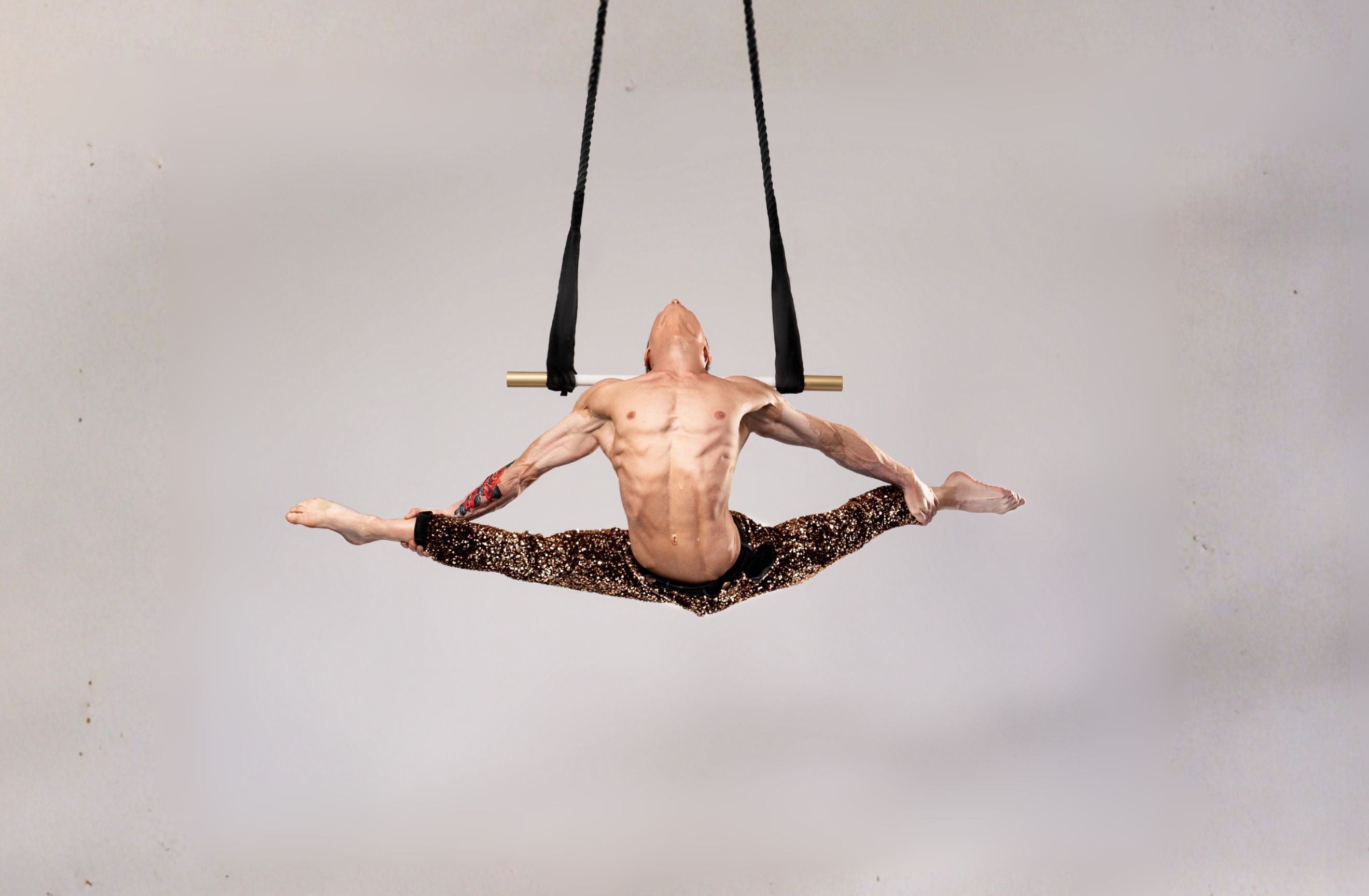
João Godinho is a professional circus artist whose work is defined not only by technical precision, but by an uncompromising relationship with discipline. A bronze medalist at the prestigious Festival de Cirque de Monte Carlo, João’s path is anything but conventional, having begun his aerial journey at the age of 30 before rapidly reaching an international level.
In this interview we explore the discipline, tension, and human reality behind elite performance, and what it truly takes to build a body capable of sustaining it.
Was there ever a moment when you felt this path might be too demanding?
Many. With this career, there is always a lot of pressure, from the market, from your body, from people around you, from everything. I’m even getting goosebumps right now talking about it. When I was training and training and training nonstop, working on all the details, my numbers, my tricks, my emotions, the music, the costumes, everything, there was a moment where I thought, okay, this is maybe too much for me mentally. I don’t know if I can handle all of this.
I am strong, and I know it because I’m a fighter, but there are limits. It’s not for everyone. If you choose to be a circus artist, it becomes day and night.

You have a very diverse background. What led you to where you are today?
I started when I was seven as a gymnast, in acrosport. I also tried trampoline, but it didn’t work because I was more attracted to acro sport, the dancing and everything. I was doing men’s four, then two men, and I finished with mixed pairs, a man and a woman, where I was the base. It was incredible. I had two Chinese coaches, Olympic and world champions, but more than that, they were incredible as human beings and as coaches. It was not just about technique; it was about how they educated me. We were training six hours per day, and they were like two angels in my life. Everything I am today, my dedication, my focus, comes from them.
After all of that, competitions and everything, I went to university to study journalism. At the same time, I started doing castings for commercials, soap operas, and musicals because I always loved to sing, act, and dance. I was trying to find myself. I liked studying, but I wanted more. I wanted to be on stage. My parents didn’t even know at the beginning. The first time my dad saw me performing, I was already the main character in a musical, Footloose, and he was completely shocked.
Then one day, while I was filming, a friend offered me to try an aerial class. I said yes, of course. My first class was silks, and I never stopped. I realised I could combine everything I love into one thing: movement, expression, story, everything together.
How old were you when you had your first aerial class?
I was 30 years old. I had finished my gymnastics career at 23, at a world championship. At that time, because of my studies and everything, I knew it was my time to leave. In university, I was already performing in musicals while still training three to four hours at the end of the day, and I was completely exhausted. I knew I couldn’t do everything at the same time. I like to focus, but you can’t do everything.
So it was about seven years without really pushing flexibility, just going to a regular gym, but not working the muscle fibres and everything you need for this kind of demanding work.

Starting circus arts a lot later than most, did you feel extra pressure?
My beginning was very confusing because I didn’t know the market. I didn’t know the circus world. It’s massive, not just circus, but shows, dinner shows, everything. Even the circus artists around me in Portugal didn’t have an international career, so I didn’t really have that reference. But I went full on. One hour was not enough for me. I was watching videos on YouTube, watching you (referring to our host Erika Lemay) and other artists, and thinking, I need to do this, but how and where? I was very lost. I started asking friends, how is it outside, because I knew immediately that Portugal was not big enough for me. I wanted more. I wanted to be a speciality act, to have a five-minute act, to be a complete artist.
So I started studying everything. The music, what songs people use, how many tricks I need, which discipline, stilts, handstands, silks. I tried different things. I even had a four-minute hand-balancing act, but I felt I was not strong enough because the market level was already very high. I was watching shows like Cirque du Soleil and thinking, they are amazing, and they are young, and I was already 30, 31, 32. How can I be at that level? So I was training a lot, hours every day, pushing flexibility, technique, conditioning. Always more, more, more. But not to be the best, to be my best version. That comes from my coaches. I know my body, I know my limits, and I just wanted to push everything to my maximum.
In the end, my first job was on a cruise ship. I created my five-minute act with everything I could, and with friends helping me. I filmed it and started sending it everywhere, emails, contacts, companies—with no experience. I just kept sending and sending, and one day I got a six-month proposal on a cruise ship. I said yes immediately. No fear. I just thought, this is the beginning.
Do you remember when discipline stopped coming from the outside and became something internal for you?
I don't want to say it was always there, but it was because of my coaches. It came from them, and then it just became part of me. I didn't even realise when it happened. It just stayed.
After that, I couldn’t run away from it anymore. I know this doesn’t happen to everyone, but for me it did. It wasn’t my parents or my family, it was my coaches. And from that moment, I just couldn’t be any different.

You recently received the bronze medal at the Monte Carlo Circus Festival. What did that moment represent for you beyond the award itself?
This is a very sensitive subject, because for many people in circus, especially those from circus families, it is a dream. But for me, it was always about working, working, working, and being the best that I can be. To feel satisfied with myself. I need to love what I see when I watch my videos. I’m not looking for other people’s approval.
Of course, there is a lot of pressure around festivals like Monte Carlo, because everyone is watching and waiting. But I didn’t go there to look for approval. I know who I am, and I love what I do. At the same time, I’m very, very grateful to the Monte Carlo Circus Festival and to all these clients and festivals that I love, because I am still meeting new people, new names in circus that I didn’t know. I love to be surprised every day, every contract, every festival. I love this world. But I’m not looking for that external approval.
For me, I just need to be okay with myself, because when I’m there, it’s just me and the trapeze. We are alone there. It’s just us.
What does the less glamorous, day-to-day reality of your training look like outside of performance?
It’s very hard. People don’t really know what is behind the scenes, especially when you are working alone. Behind the scenes can be very lonely. I have my routine and I am very demanding with myself. I don’t want to fail. I want to work, I want to be my best version, and sometimes it’s not pretty. It’s really not pretty.
My dad once told me, ‘You keep living in your wonderful world,’ and I said, ‘It’s not a wonderful world like you see in videos. There are a lot of tears, a lot of pain, sometimes even depression and sadness, but also happiness. It’s a rollercoaster. My life is a rollercoaster.’
I’m very obsessive about my job. I always say I’m not single, I’m married to my career. Everything revolves around my routine, my conditioning, my prop, my costumes, and my body.
And the body is everything. We need to respect it, because if we don’t respect our body, we are not going to survive in this field.

How do you recognise when pushing yourself is productive and when it becomes destructive?
I am able to identify it. I’m lucky enough to feel my body and also my brain. Sometimes I reach my limit when I’m pushing too hard to achieve a specific trick, and my body starts to behave differently. That’s when I know. I know when it’s productive and when it’s not.
For example, even with diet, I take care of my body. I can still eat chocolate and everything, but I have my structure. For the last festival, I had all my meals prepared every day. I went to Monte Carlo, and I didn’t eat at the canteen; I brought my own food. I think for them it was difficult to understand, maybe they thought I was arrogant, but it’s not that. It’s just my normal food, rice, chicken, protein, what I’m used to. I didn’t want to change anything and risk my body reacting.
I just needed to keep stability for my body, so nothing feels different when I’m performing.
Does that level of structure and obsession ever backfire? Do you notice when it starts going too far?
Oh my God, yes. With all of this, being focused and obsessive with the job, we need to be careful because there is a line. There is a line, and in my case, the body I can control, but it is much more difficult to control what is happening in my mind. Going back to the previous question, when I am too strict with myself, with the diet and everything, I start to lose weight, and that is my alarm.
When I see myself losing that extra kilo or two, I know my body is telling me to stop. It is too much. Too much of the new act, the new song, the new training, the new conditioning, the new costume. Everything becomes a real obsession. That is when I know I need to stop and pause and say, okay, calm down, take it piece by piece, control this.
So those are my signs. Usually, they show up in my body first. When I start to get too skinny, I know something is not okay and I need to slow down a bit and reassess everything.

How has your relationship with your body evolved over time?
I started to respect my body and give to my body what it wants and what it needs as well. It’s very interesting how we can feel our body and its needs. Sometimes my body needs sugar, for example. It’s crazy, because I don’t like to eat sugar and I try to avoid it. For me, sugar behaves like a drug, like an addiction, so I don’t want to give that to my body.
So yes, now I feel my body more and I respect it more. I know how I need to do things. Even with food, for example, I don’t take protein powders or BCAAs or all of that. I know it works for some people, and I respect that, but it doesn’t work for me. I don’t feel well taking all these extras, so I try to stay more natural.
The only thing I take now is vitamins, because I feel that the food nowadays doesn’t give my body everything it needs, unless you eat very large quantities, which is not sustainable.
What supplements do you take, and how do you approach them?
I take a lot of things. I take vitamin C, zinc, magnesium, ginger, omega, but not the one with fish oil because it makes my stomach feel a bit sick. I also take D plus K, B-complex, and that’s mostly it. And I take FLEXIBLE Collagen from LEMAlab as well, always with my coffee in the morning. That one is my favourite. It was studied specifically for bodies like ours, artists, gymnasts, and people who require more from their bodies.
And for me, it’s really part of my routine. I don’t say this to sell anything, but because I actually feel it. If I stop for a while and then start again, after two or three weeks, my body feels different again. I feel looser, less stiff. I don’t even like to use the word ‘flexible’ because it’s the name, but it’s real, I feel it in my body.
Also, I always say to my friends, be careful. You cannot just go to the supermarket and buy cheap supplements. Cheap is expensive when it comes to your body. That's why I'm always defending this product with all my friends. Like you are taking something really serious here. There was a team of experts studying all of this.
Was there a moment when your body forced you to completely rethink your approach to training and recovery?
Yes, because of my shoulders. When I was trying to create a straps act, I was training a lot, straps and straps and straps, with that old-style technique, the roll-ups and the switches, everything on the shoulders. One night, around 4 or 5 am, I woke up and I couldn’t lift my arm. Nothing had happened the day before. I had performed in the evening and felt nothing. But suddenly I had pain and I just couldn’t lift it.
So I had to go back a bit. Maybe that was the moment when my respect for my body really started. It wasn’t something massive; I recovered with physiotherapy and rest, but for about two weeks, I couldn’t lift my arm properly. I was desperate, doing exams, seeing doctors, dry needling, everything, because this is our working tool. In the end, everything was fine, but I had to adapt. I even kept performing using my left side instead of my right shoulder, adapting the act, even when the client told me to stop.
Now I know when my body speaks to me. I can recognise the signs, with shoulders, hips, flexibility, everything. And I know when it’s time to stop and adapt.

Have you experienced doctors catastrophising injuries, and how did you find the right support?
Yes, with my neck. About two years ago, I started to feel something there, and for me it was very scary because I fly with my neck. It’s my last trick, I lock my neck and I spin. So, of course, I went straight to a doctor, and, like always, the first thing he told me was, ‘You can’t do this anymore; you need to stop.’ And I was like, what do you mean? This is my job, this is my trick. I cannot just stop.
So I started searching for specialists until I found the right physiotherapist. He was the first one to tell me, why would you stop? You don’t need to stop. We just need to adapt, understand what is happening, and recover. He explained that yes, it’s not perfect since I’ve been using my neck in this way for years, but it’s not the end of the world. There are people with similar issues who work at the computer all day, and you can work around it and make it stronger again.
That really changed my perspective. It’s not always the end. You just need the right professionals and the right approach.
What is the hardest part of this job, physically or mentally?
Mentally. Things are changing all the time, like everything, and we need to adapt and adapt and adapt. I don’t even know if I can answer this perfectly, but it’s definitely mental.
It’s juggling everything, clients, agents, your body, the performance, flying, travelling all the time, planes, food.
Do you ever wish for more freedom, or is discipline your form of freedom?
Sometimes I wish for more freedom, yes. Sometimes I even say something that maybe people don’t like, but I feel like I am a slave of my body and my career. That’s how it feels sometimes. For me, there is no other way. This is how it works for me, because of my way of doing things. Sometimes I would love to have more freedom with food, with conditioning, just to relax a bit more like other people.
For example, I have tricks that I don’t feel comfortable going more than three days without training for. Three days is my limit. If I stop longer, I don’t feel safe anymore. So I travel with my own bar to keep training, even on holidays. Because for me, it’s also about respect, respect for my body and respect for my tricks. But yes, sometimes I would like to just go out with my friends, have fun, be free, go on holiday without thinking about training.
But even when I go somewhere, which is very rare, I need to know there is a gym. That’s my reality. My holidays are like that. I still train, two or three hours, otherwise I feel anxious.

Do you have something you tell yourself to stay committed on days you don’t feel like training?
My body just goes. It’s very interesting, because there are many days where I feel exhausted and my brain is already saying, no, just stop. But my body goes with the flow, or my brain follows my body, I don’t even know how to explain it. I just know that my training is there waiting for me. Like right now, after this interview, I know I need to go to the gym for three hours, do my cardio, my exercises, my conditioning, and my body just goes.
Sometimes it’s a fight, I really don’t want to go, I just want to relax and watch a movie, but I go anyway. It’s like I am able to switch off my brain and just do it.
What has this path taught you that nothing else could have taught you?
Discipline. The word of my life and my career is discipline. It’s not obsession, it’s not anything else, it’s discipline. I couldn’t do all of this without it. It comes from my coaches, those two beautiful people I met when I was very young. I still think about them every week, even after so many years without seeing them. They know what I do now, and they are proud.
For me, it’s discipline and education. There is no other way. I’m even getting emotional speaking about it, because it’s very deep and there are so many things people don’t talk about. But for me, it’s simple. It’s discipline.
Is there anything else you would like to share with our audience?
Take care of your body, please. I always say this to my friends, especially the younger ones, 20 to 25, 28. Please take care of your body. This is not a joke. I know you feel powerful right now because you are young, but if you want to do this until your forties or fifties, you need to take care of it.
You need to respect your body. Be kind to your body. This is the way to survive in this career. And also be kind to your mind and to the people around you.
*This interview was originally featured on The Flexi Podcast, the LEMAlab® podcast hosted by Erika Lemay. The full episode is available on Spotify and YouTube.